Scroll through the scenes or use the chapter links. The sources and version notes follow the story.
When the story or a chapter is focused, use arrow keys to change scenes, Home for the beginning, and End for the ending.
01
A young traveller seeks a teacher
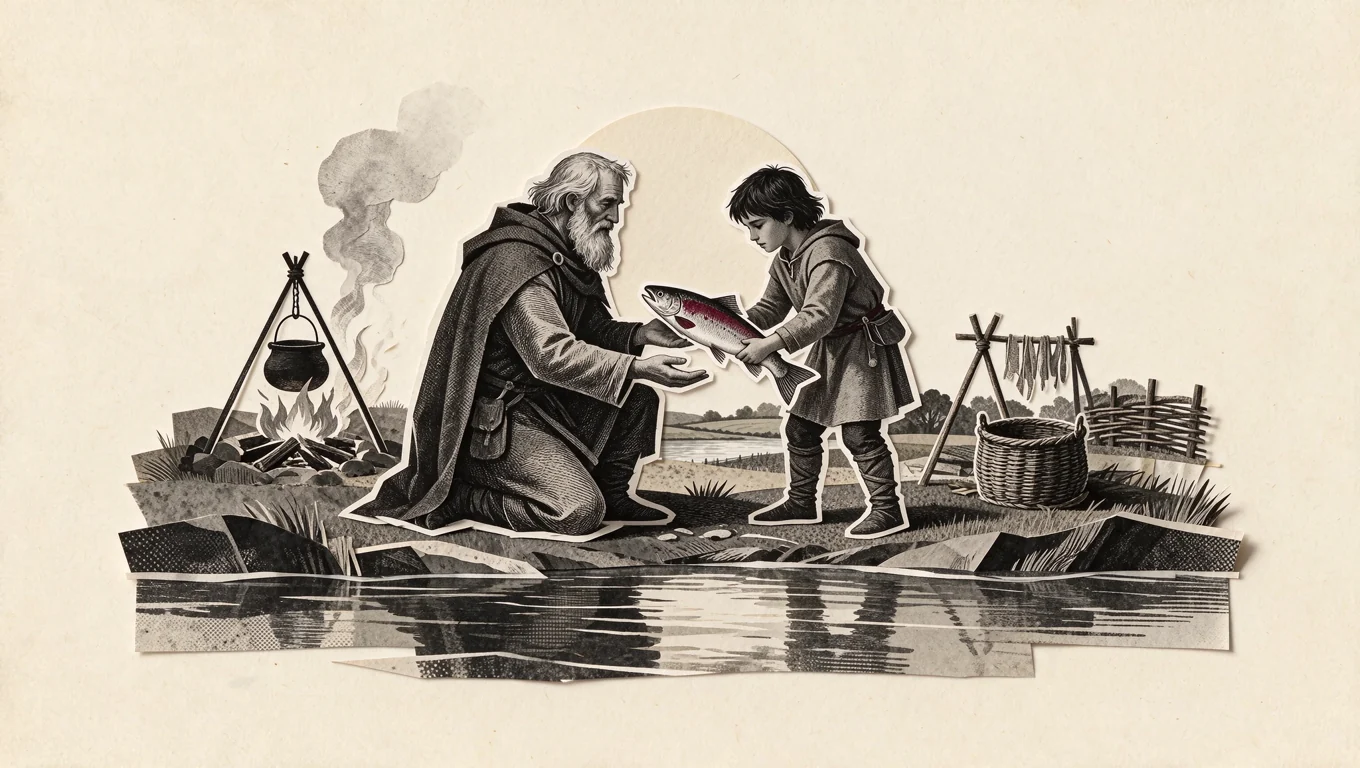
Before the boy became the celebrated Fionn, he was called Demne. In The Boyish Exploits of Finn, his early life belongs to a dangerous world of rival families and the scattered followers of his father Cumall. He eventually came to the Boyne to learn poetry from a teacher named Finnéces, commonly called Finnegas in modern tellings. The change of setting matters. The young traveller is not simply looking for another fight to win. He enters a place where knowledge, words and the work of learning can become forms of strength.
The teacher had spent seven years watching for the salmon of Féc’s Pool on the Boyne. A prophecy connected eating that fish with extraordinary knowledge: afterward, nothing would remain unknown to the one who ate it. The waiting gives the salmon a value beyond any ordinary catch. Years of expectation stand behind the moment when it is finally found. Demne has arrived near the end of a patience he has not himself had to endure. He will be given a practical task, apparently small beside the teacher’s long attention to the river.
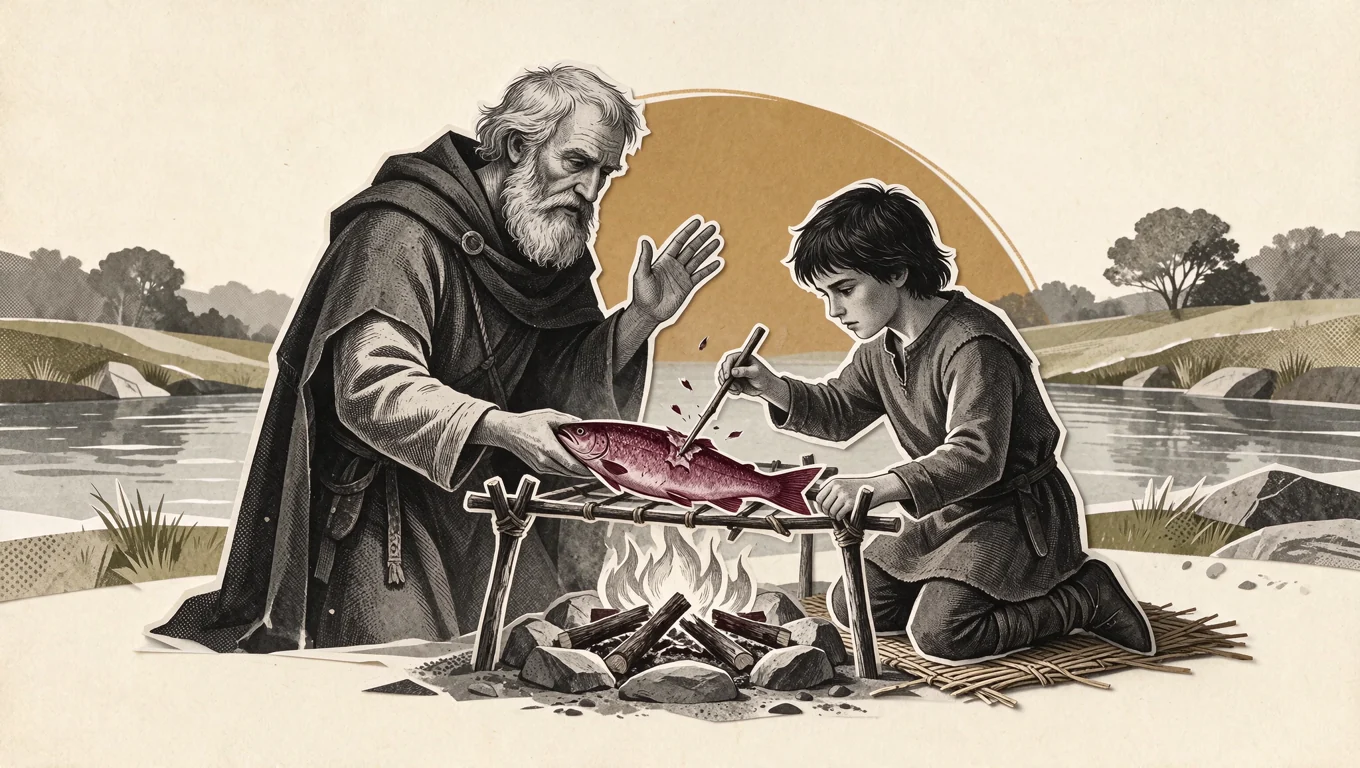
The salmon was caught, and Demne was ordered to cook it. His teacher’s instruction was clear: he must not eat any of the fish. The young helper therefore had to prepare something valuable while leaving it for someone else. There is no need to add a secret plan to his work. The account gives him an ordinary duty inside an extraordinary situation. The salmon still has to pass through the hands of a cook before it can be eaten, and those hands will bring the prophecy into an unexpected relation with the boy.
In the marginThe names are part of the recognition+
The CELT translation uses Demne before the recognition and Finn afterward; the teacher is Finnéces. Finnegas and Fionn are familiar forms elsewhere. Different spellings need not mean different people, but the naming moment in this passage still deserves attention.
As Demne cooked the salmon, he burned his thumb. The source gives the accident briefly, without a long explanation of how he touched the fish or what particular cooking device he used. This telling leaves that precision open. He put the thumb into his mouth to ease the hurt. It was a small, immediate response to pain, not a deliberate decision to steal his teacher’s meal. The event becomes important only when the teacher begins asking about what has happened. A heroic gift has approached through the most unheroic of gestures.
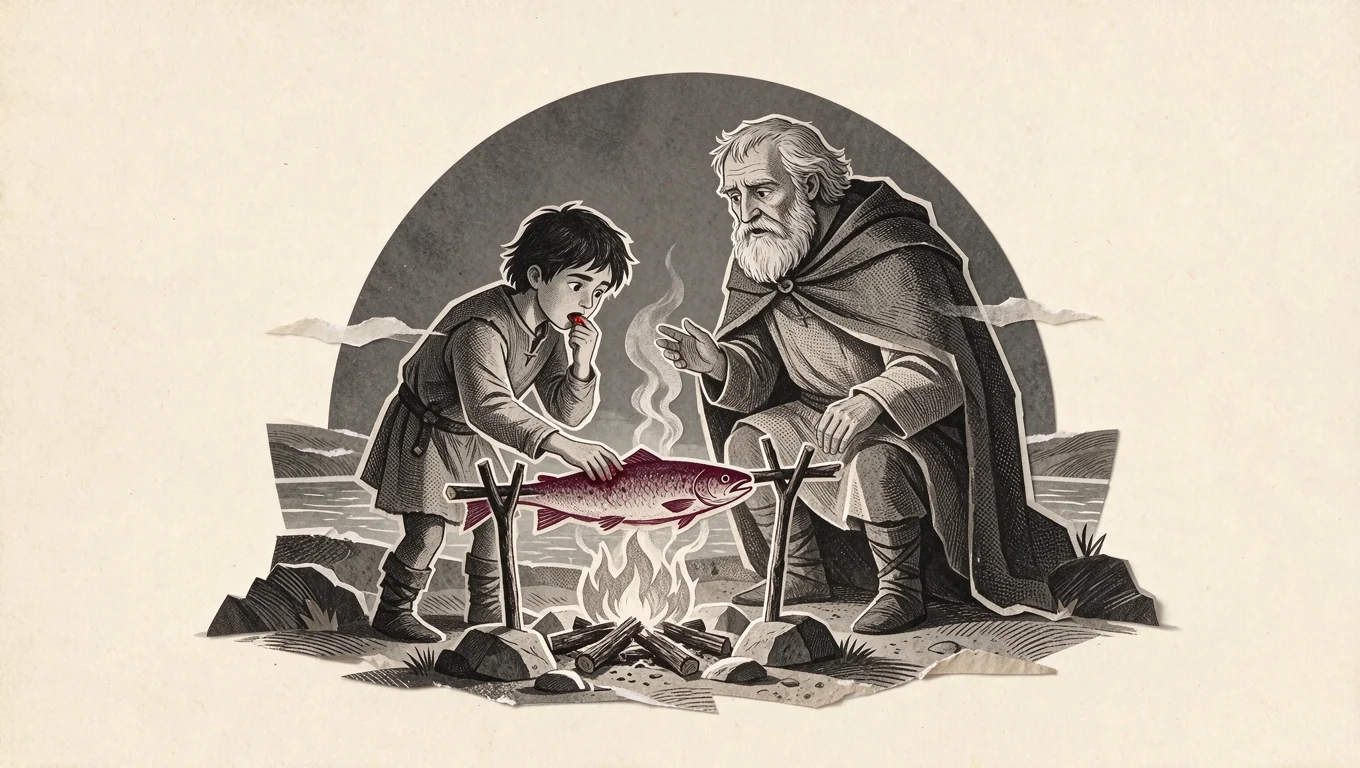
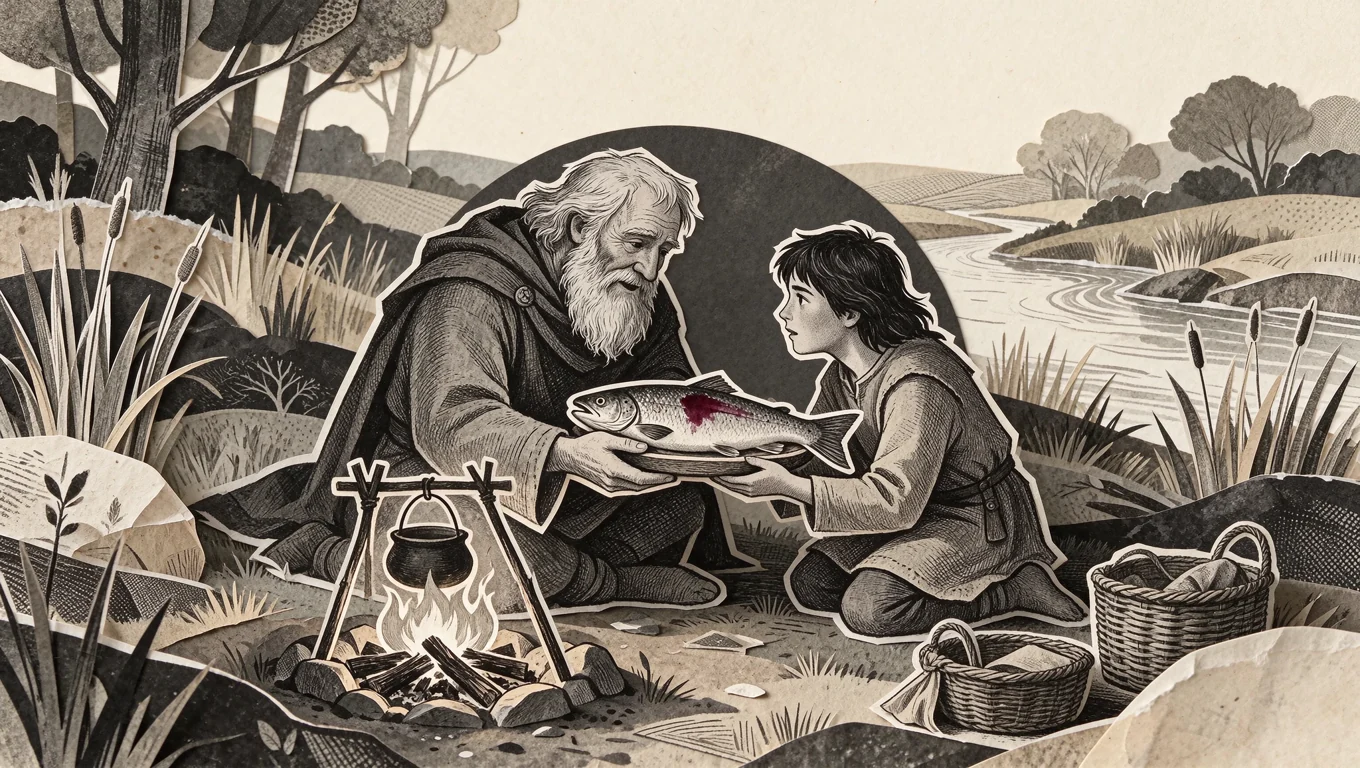
Demne brought the cooked salmon to the poet. The teacher asked whether he had eaten any of it, and the boy explained that he had not, but had burned his thumb and put it in his mouth. The answer does not become a confession of a planned theft. It allows the poet to recognise the meaning of the accident. The teacher then asks his name. For a moment the larger story of the awaited fish narrows to a conversation between two people, one of whom has not yet understood the significance of what he has just done.
The boy gave his name as Demne. The poet answered by naming him Finn and declaring that the salmon had been given to him to eat. The revelation reverses the apparent relation between the old watcher and the young helper. The one who has waited for the fish recognises that the gift belongs to the newcomer. He does not try to undo the accident or punish the boy for it. In this version, the transfer of the meal is explicit: the teacher gives the salmon to the person he now understands it was meant for.
The chosen passage gives the long wait, cooking, burned thumb, recognition and meal. A detailed hazelnut or sacred-well prehistory should not be added merely because another familiar salmon story includes it. Let the boundary of this source remain visible.
Demne, now named Finn, ate the fish. The text connects the resulting knowledge with a later practice: when he put his thumb into his mouth and performed the poetic utterance called teinm láida, what had been unknown could be revealed. The account is more particular than the simple claim that a single touch made him know everything at every moment. The meal, the name and the practice belong together. Fionn’s future gift grows from the scene at the fire, but it takes its place within a world where poetry and inspired knowledge are connected.
The Boyish Exploits continues by saying that Finn learned the three things that constitute a poet, naming teinm láida, imbas forosna and dichetul dichennaib. It then gives a poem celebrating Maytime: birds, changing weather, growing woods and the movement of animals and water. We do not reproduce its words here, but its position is suggestive. The extraordinary meal does not lead only to a display of power. The tale also brings its young hero into an art of noticing and speaking about the living world. The river has given him a story; the learner must still become a poet.
This telling follows The Boyish Exploits of Finn, chiefly sections 17–19 and the following Maytime poem, in Kuno Meyer’s 1901 translation presented by UCC CELT. It distinguishes the boy’s names, the teacher’s name and the later poetic practice rather than importing every familiar salmon motif.
Finnéces, Finnegas and Fionn
The CELT text uses Finnéces for the teacher and Demne for the young hero before the recognition scene, then Finn. Finnegas and Fionn are familiar forms used in later and modern tellings. This page signals those differences rather than inventing separate people to explain every spelling. The name change and the teacher’s acknowledgement are central to the episode.
Many popular salmon stories include hazelnuts, a sacred well or a detailed account of how wisdom entered the fish. Those are not added to this telling merely because they are familiar elsewhere. The selected passage gives the long wait, the prophecy, the cooking, the thumb, the recognition and the meal. Its continuation links the hero’s gift with named poetic practices. Reading the following Maytime poem offers a richer ending than treating knowledge as an object won and immediately mastered.
The young learner whose name and future change beside the cooking fire.
Finnéces / Finnegas
The poet who watches for the salmon and recognises its destined recipient.
The salmon of Féc
The fish whose eating is associated with extraordinary knowledge.
Reading beside this telling
Related reading for this story and its named tradition. Modern retellings and other translations are distinguished from the exact sources used above.
Early Irish Myths and Sagas — translated by Jeffrey Gantz
For context in early Irish literary traditions: Jeffrey Gantz’s named translations. This is related reading; it is not a claim that this particular tale occurs in the volume.
For broader context across Celtic traditions: a modern illustrated collection. Irish and Welsh traditions are distinct, and this book does not replace the linked CELT source.
Optional purchases. Use what you already have. As an Amazon Associate I earn from qualifying purchases. Check the exact edition or model before buying.