Scroll through the scenes or use the chapter links. The sources and version notes follow the story.
When the story or a chapter is focused, use arrow keys to change scenes, Home for the beginning, and End for the ending.
01
A marriage and a loss
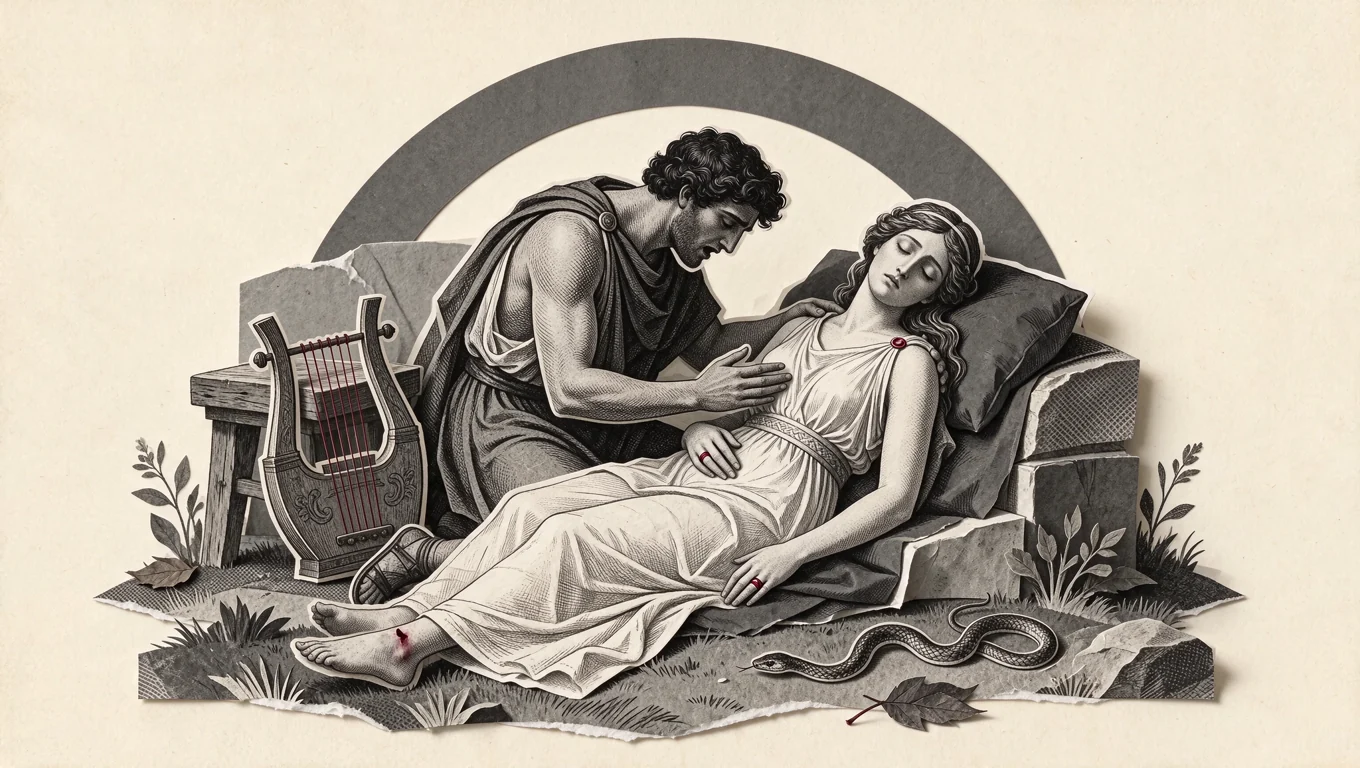
Orpheus was a musician, and Eurydice was the woman he had just married. Ovid begins their story with an uneasy wedding: the marriage torch will not burn brightly, and the ceremony offers no reassuring sign. Soon afterward, while the bride is walking with her companions, a snake bites her ankle. She dies. The poem does not allow the new household time to grow ordinary. For Orpheus, the music that once belonged to a future together becomes a way of addressing someone who can no longer answer from the living world.
He mourned above the earth, but mourning did not satisfy the wish that drove him. At last he undertook the journey down to the dead. Ovid places his descent through the Taenarian entrance, among the shades and the darkness of the lower world. Orpheus does not arrive as a conqueror with an army. He carries the art by which he has moved listeners before. The journey asks an impossible question: might the power of a song reach beyond the boundary that every living person must eventually cross only once?
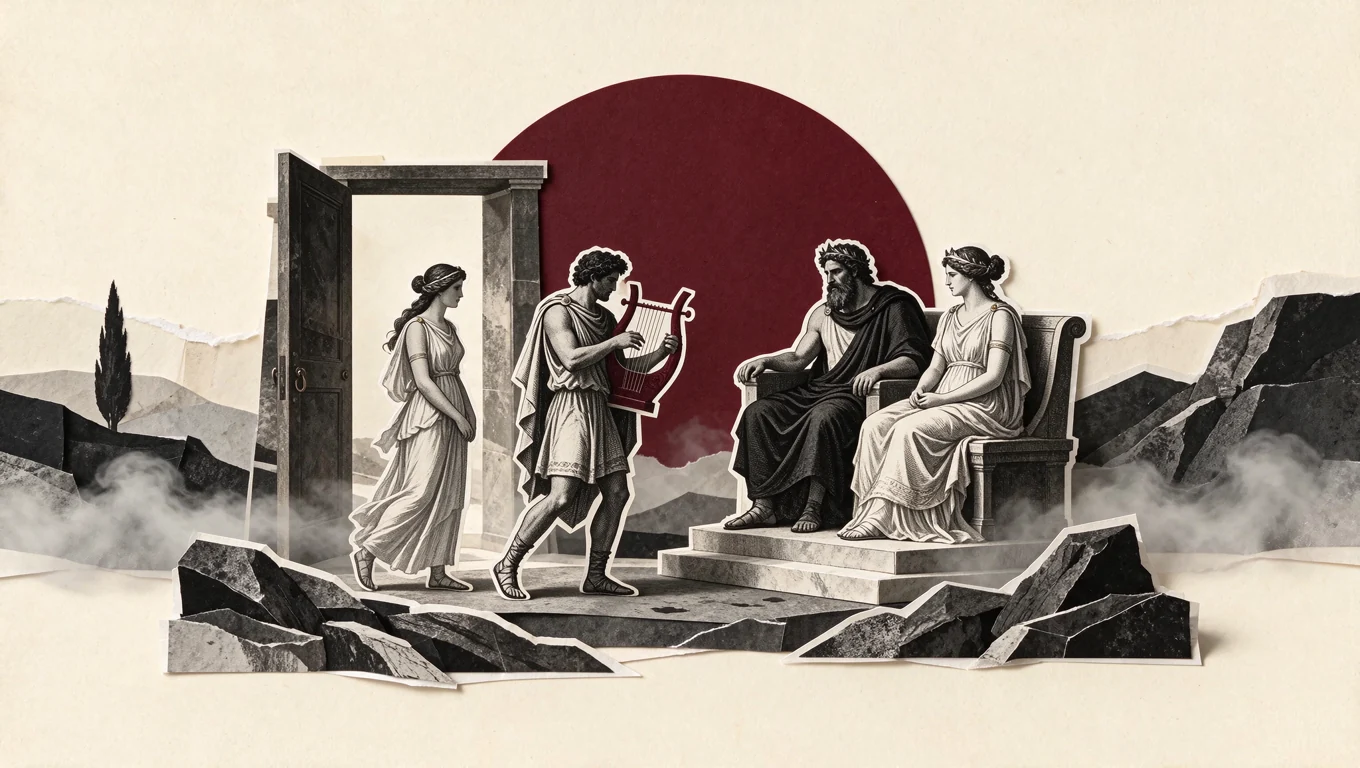
Orpheus played before Persephone and the ruler Ovid calls Pluto. His appeal acknowledged their lasting authority. Every mortal would come to them in the end; he was asking for Eurydice’s years above, not for an exemption from death forever. He spoke from love and grief rather than pretending the loss was easy to accept. In this telling, song makes an argument as well as a beautiful sound. The musician asks the rulers to imagine time returned to a life cut short, while admitting that the final destination of that life would still be theirs.
Ovid lets the song interrupt the activity of the underworld. Listen for the pause before looking for the bargain: the audience is being changed before a condition has even been set. That sequence gives the music a different role from a password that opens a gate.
The underworld listened. Ovid imagines famous sufferers stopping their endless labours and the Furies themselves moved to tears. These are poetic signs of an extraordinary interruption: a realm defined by what cannot change briefly becomes attentive to a new request. Eurydice was called from among the newly arrived dead. She came slowly, still marked by the wound that had killed her. The rulers allowed her to follow Orpheus upward. For the first time since her death, the road ahead seemed to contain a shared future rather than only his solitary return.
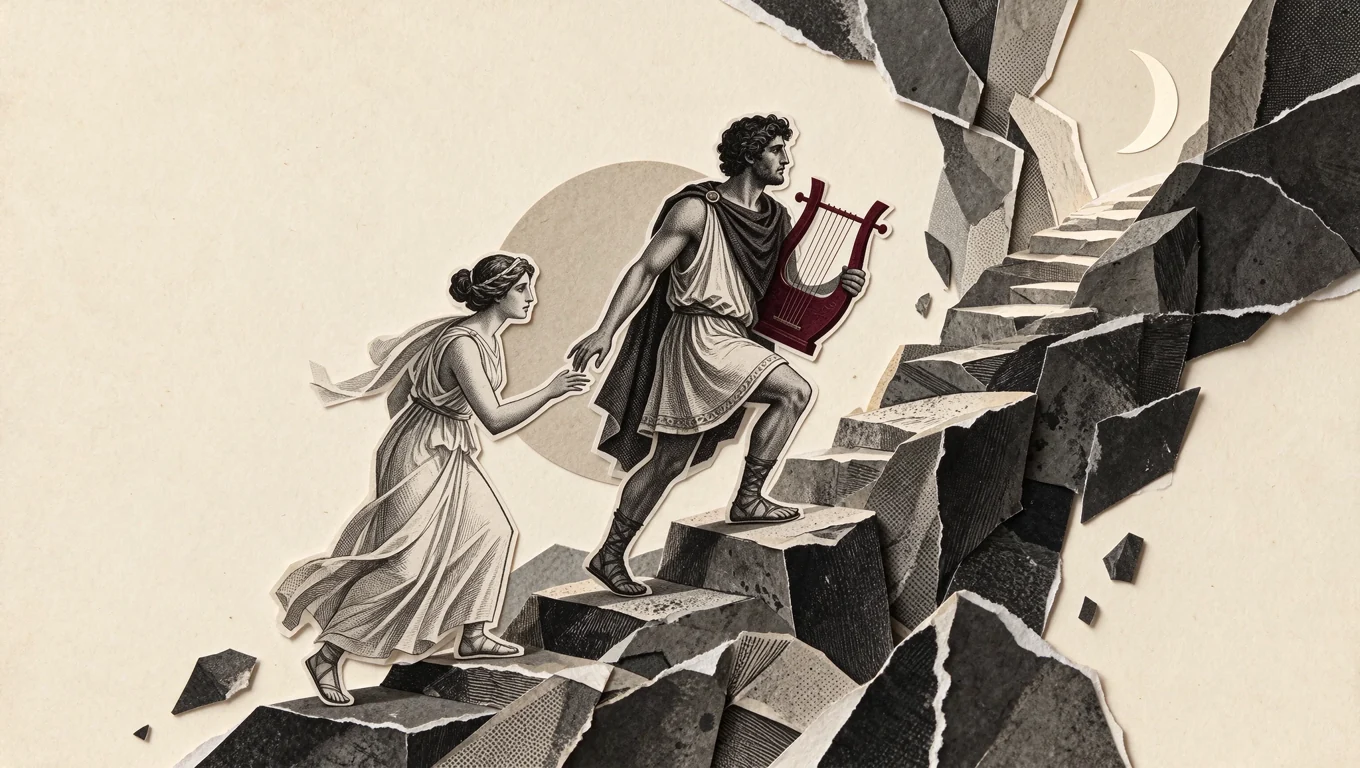
There was one condition. Orpheus must not turn to look at Eurydice until they had left the underworld. She would come behind him, beyond the confirmation of his eyes. They set out along a steep, dim path in silence. The gift he had won therefore required a different skill from performance: he could not solve the next stage by making others listen. He had to continue forward without seeing the person for whom the journey mattered. Nearness and uncertainty could now grow together with every step.
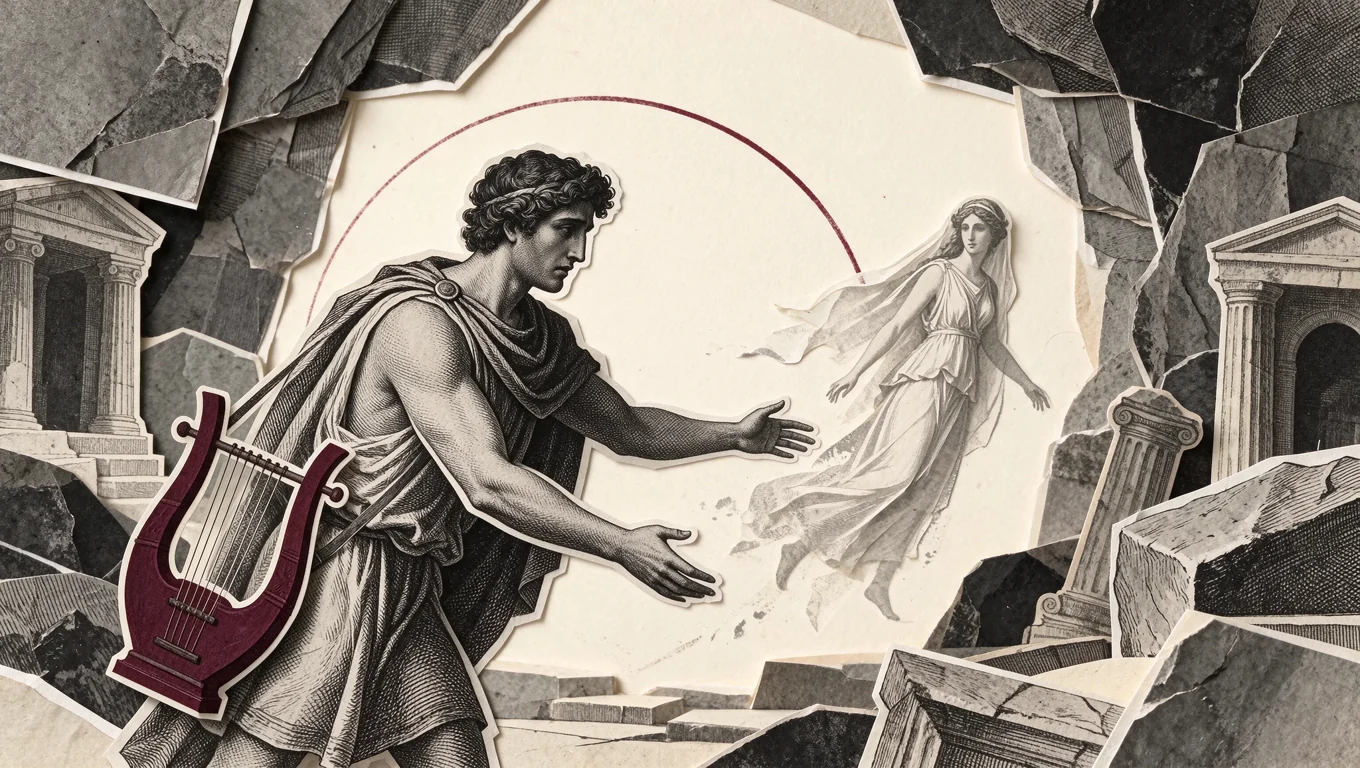
They came close to the upper world. Ovid makes the failure happen when little of the climb remains. Orpheus fears that Eurydice may not be there, and he longs to see her. He turns. The act is small beside the descent and the song, yet it breaks the condition on which the whole return depends. Eurydice slips away. His arms reach toward her and find only air. This shortened telling leaves their last exchange without invented dialogue. The poem’s devastating movement is enough: the person who was almost restored is lost a second time.
In the marginEurydice does not answer identically+
Virgil’s account belongs within the story of Aristaeus and gives Eurydice a different response at the second loss. Keep the two authors’ speeches apart. A sentence made from both can sound convincing while belonging to neither poem.
Orpheus tried to go back. He asked the ferryman for another crossing, but the way was refused. Ovid keeps him by the river for seven days, without food, sustained only by the grief and anxiety of his loss. Eventually he returned to the upper world. The journey has not revealed a reliable method by which love can defeat death. It has shown a singular permission, a condition and a failure. Orpheus must now carry a memory of both the original loss and the brief walk in which a different ending seemed possible.
His life and music continued beyond this episode, and Ovid’s larger poem follows further songs and a later fate. Here we stop with Eurydice’s failed return. The limit of the telling lets the silence after the climb remain. Music brought the rulers to listen, but it did not make Orpheus immune to fear, longing or a mistaken movement. Those who retell the story can return to the path, hear the condition again and hope for a moment that this time he will keep walking. The ending remains the same; the act of attending to it does not.
The principal story follows Ovid’s Roman Metamorphoses, Book 10. It is a literary version of a wider Greek myth; the ending here is gentle but does not change its loss.
Ovid, with Virgil beside him
The principal sequence here follows Metamorphoses 10.1–85. Virgil’s Georgics 4 also tells of Orpheus and Eurydice, within the story of Aristaeus, and gives Eurydice a more reproachful response at the second loss. The accounts should be compared rather than combined into an invented single quotation or a claim about what every Greek audience believed.
Readers can understand the backward glance as distrust, anxious care, an irresistible wish to see, or several things at once. Ovid explicitly gives fear and the desire to look a place in the failure. This adaptation does not supply a test devised to punish an insufficiently loving husband, nor does it make Eurydice responsible for his turn. Her interrupted life remains the reason for the journey.
Musician who asks the rulers of the dead to restore his wife.
Eurydice
His newly married wife, killed by a snake and permitted one conditional return.
Persephone and Pluto
The rulers below, whose permission carries the condition.
Reading beside this telling
Related reading for this story and its named tradition. Modern retellings and other translations are distinguished from the exact sources used above.
Metamorphoses — Ovid, translated by Mary M. Innes
For this story’s Ovid reference: read Book 10 in Mary M. Innes’s prose translation of Metamorphoses. The open source linked above uses its own translation; compare named passages, not identical wording.
Optional purchases. Use what you already have. As an Amazon Associate I earn from qualifying purchases. Check the exact edition or model before buying.