Scroll through the scenes or use the chapter links. The sources and version notes follow the story.
When the story or a chapter is focused, use arrow keys to change scenes, Home for the beginning, and End for the ending.
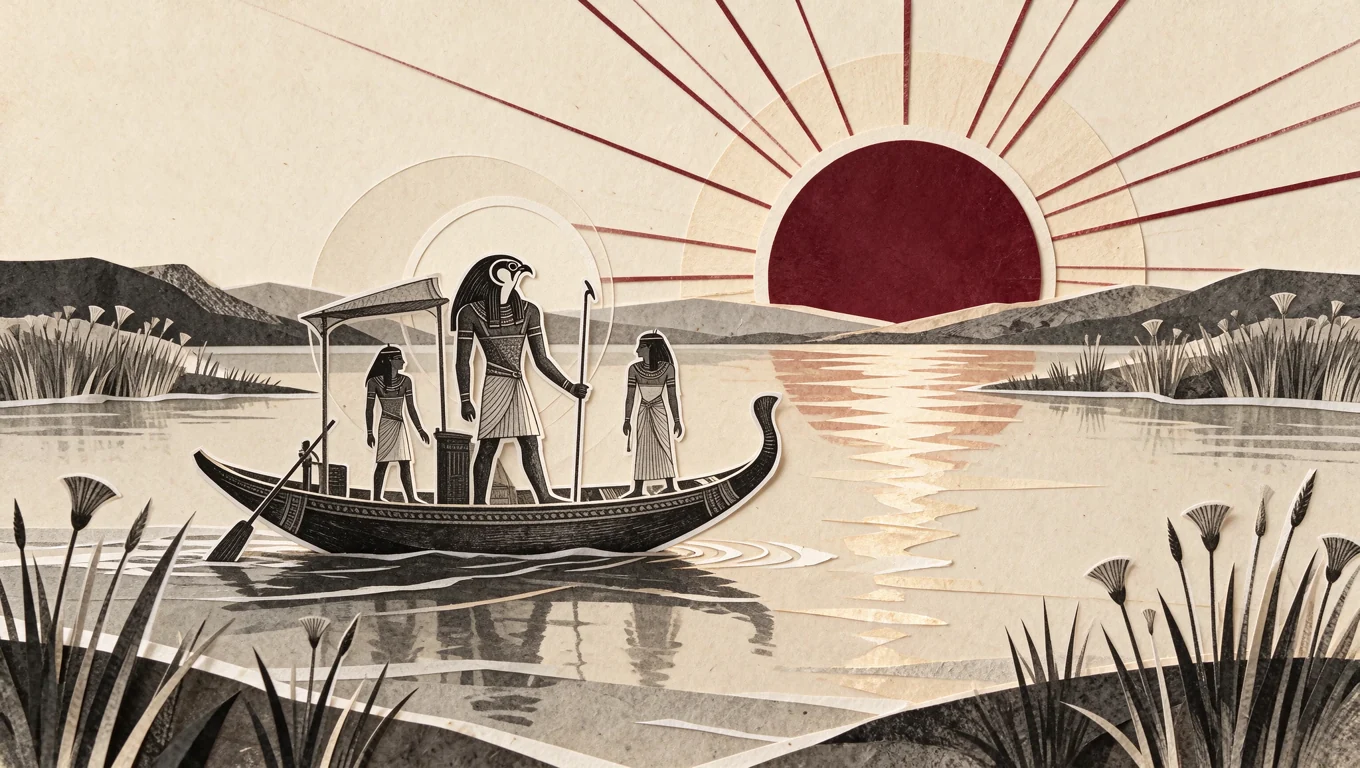
Reused from our solar-journey telling: an image of Ra’s returning light, not a depiction of the snake-bite episode.
01
A god with something still hidden
Ra moves through the world he has made. His titles speak of creation, daylight and the ordering of time; his followers know the majesty of the sun. Yet this telling begins with a difference between what can be announced and what remains concealed. Ra possesses a name that is not available to those around him. Isis has knowledge and skill of her own, but she wants access to this guarded source of power. The narrative does not begin with an equal exchange between two people who trust one another. Something one figure needs is being kept inside the other.
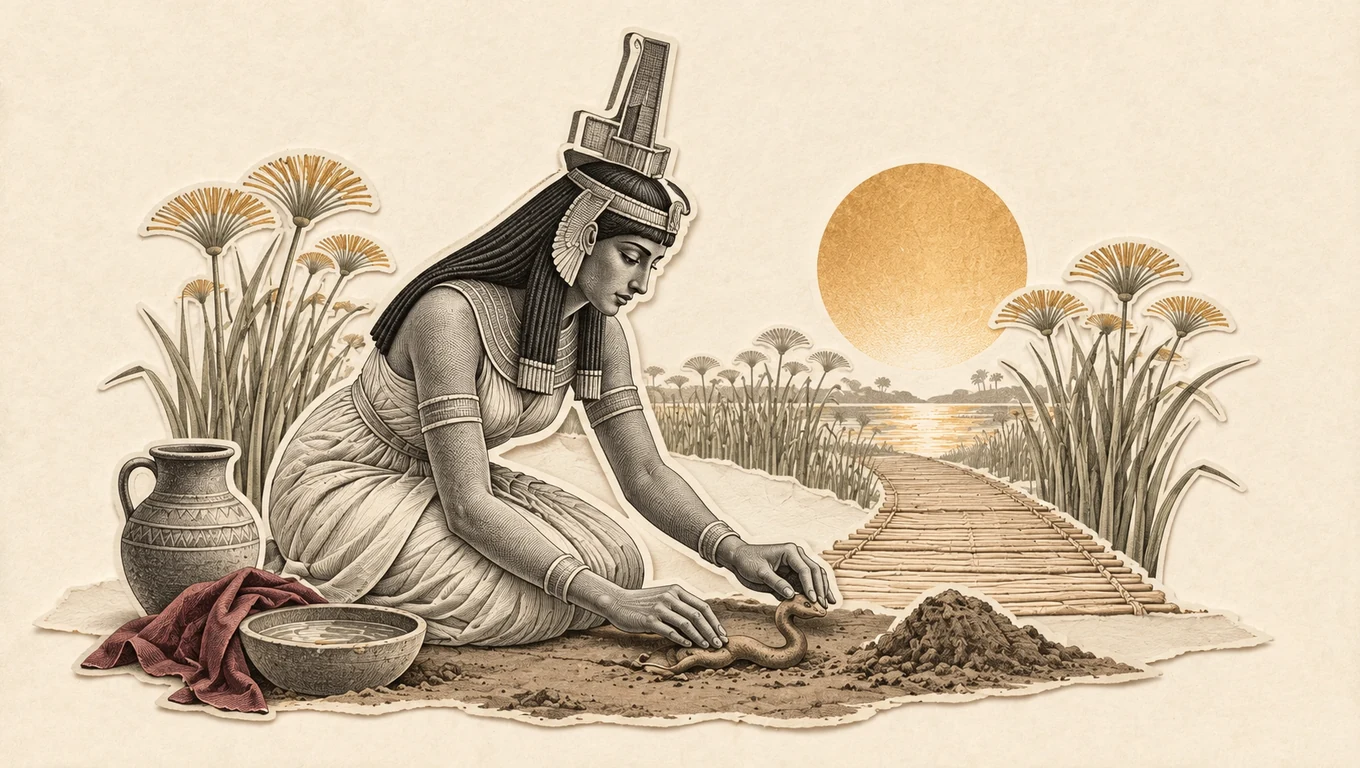
An interpretive illustration of the clay-snake episode. The snake is distinct from Apep, and the picture does not document an ancient ritual.
02
Earth and a trace of the divine
The sun god is also old in this story. As he passes, saliva falls from his mouth to the ground. Isis gathers it with earth and shapes a snake. The material is important to the plot: this danger is made using something that has come from Ra himself. It is neither an ordinary enemy arriving from outside creation nor the enormous Apep of the night journey. Isis places the creature where Ra habitually walks. The familiar route has become a trap. Nothing in the account asks the reader to admire the act as harmless cleverness; the knowledge she seeks will be obtained through pain.
The snake bites. Ra cries out, and the disturbance travels through the divine company. His body shakes; the pain does not fit his knowledge of the things he has created. The contrast is sharp: the maker of an ordered world cannot identify what is happening within his own body. His companions gather, but their presence does not immediately bring relief. For a moment the mighty names are unable to do the work expected of them. The story has brought a god into a condition that a vulnerable human patient could recognise, without turning that comparison into a claim that the god was an actual patient.
Apep’s obstruction of the solar journey is a different narrative from the clay snake made by Isis. Shared characters and serpent imagery do not make the two plots interchangeable. This telling follows the healing incantation identified by UCL.
Isis approaches with the ability to act. Her speech, in this telling, can bring breath and drive away suffering. She offers the prospect of help, but also sets the condition on which it depends: Ra must disclose his name. This is the same goddess who arranged the danger, not an uninvolved healer who has happened upon it. The episode therefore leaves an uneasy relationship between care and coercion. What is effective need not be innocent. A reader may admire the force of Isis’s knowledge while still noticing how she has made the need for it unavoidable.
Ra gives an account of what he does. He has made the world and its creatures; he governs light and darkness and the passage of the year. The succession of identities is magnificent. It also fails to answer the demand. Isis recognises that a catalogue of achievements is not the concealed name she has asked to know. Meanwhile the poison continues its course. This delay makes the distinction audible without providing an invented magical word. A public name can describe a role, a title can proclaim authority, and yet the narrative can insist that another kind of knowledge remains out of reach.
Ra finally permits the hidden name to pass to Isis. The transfer is intimate and restricted. Horus may receive it under the condition specified in the telling; it is not announced to the assembled gods or written out as a gift to the reader. Isis can now command the poison to depart. The movement of power is followed by a movement toward life. Ra’s recovery closes the immediate crisis, but it does not erase the way the crisis was created. The goddess has gained what she wanted, and the god has needed another being’s knowledge in order to survive.
Ra’s titles are heard by the audience; the hidden name itself is not supplied as a word a reader can use. Notice the difference between learning that a secret has been transferred and receiving that secret yourself.
The final words turn from Ra to the sufferer for whom the text is being used. A human recovery is linked to the divine recovery. That shift explains why a tale of a hidden name could be preserved in a collection concerned with venom and healing. The story is doing work within the ritual imagination of its users. Read today, it remains a narrative about an extraordinary bargain, and also a surviving record of how people tried to answer bodily danger with meaningful speech. The sun continues; the name stays undisclosed to us. The story ends by making room for a life beyond the divine dispute.
An original adaptation of the snake-bite incantation presented by UCL Digital Egypt, read beside E. A. Wallis Budge’s 1912 translation. Its setting is a healing text, not an account of a historical poisoning. This is a different story from Ra’s nightly struggle with Apep. The clay-snake illustration is an interpretation of this episode; reused solar and Isis details identify the characters. No image documents an ancient ritual.
A story inside a remedy
UCL identifies several Ramesside witnesses from Deir el-Medina, including papyri and inscribed fragments. The narrative ends by connecting Ra’s recovery to the recovery of a named patient. That ritual setting matters: it gives a purpose to the story’s movement from divine danger to restored life. It does not establish that the treatment is medically effective.
Ra transfers knowledge to Isis, but the text does not hand a usable secret name to its audience. A list of divine titles is not the same thing as the hidden name in the plot. The story can invite questions about dependence, power and the price of help without making Isis simply generous or simply cruel.
A goddess skilled in speech and healing, seeking hidden knowledge.
Ra / Re
The creator and sun god whose hidden name is a source of power.
Horus
Isis’s son, named as the permitted future recipient of the secret.
Reading beside this telling
Related reading for this story and its named tradition. Modern retellings and other translations are distinguished from the exact sources used above.
Egyptian Myths — Jean Menzies
For the Egyptian tradition behind this story: a modern illustrated collection. Keep the museum evidence and this later retelling distinct; this is not an ancient primary source.
For another modern approach to retelling Egyptian stories. Compare version choices rather than assuming it reproduces the exact source used on this page.
Optional purchases. Use what you already have. As an Amazon Associate I earn from qualifying purchases. Check the exact edition or model before buying.